Showing posts with label sea. Show all posts

Thursday, April 11, 2013

Ubari or Awbari Oasis lake Sand Sea of Fezzan, Libya


Recent archaeological research revealed the existence of several fresh-water lakes, known as palaeolakes, in ancient Fezzan, Libya. Some of these lakes were located in the southern regions of Wadi Irawan, Wadi al-Ajal and the Ubari Sand Sea. The archaeological finds from the area include dark layers of organic matters, shells, hand axes and other Palaeolithic and Neolithic implements and tools which strongly suggested ancient human activity in Fezzan. These lakes were part of a larger network of lakes which have included the legendary nearby Lake Tritonis and Lake Chad among numerous other smaller lakes.


Precise dating of the lakes is yet to be confirmed, but current studies, conducted by the Fezzan Project, suggest Pleistocene and Holocene human presence. However, results from Wadi al-Ajal's playas (: which are mud flats with rough surface, cracks and salt encrustation, like the Playa of Germa which represent the lakes just before drying out) indicate these lakes to have disappeared around 3000 years ago.


Thursday, March 14, 2013

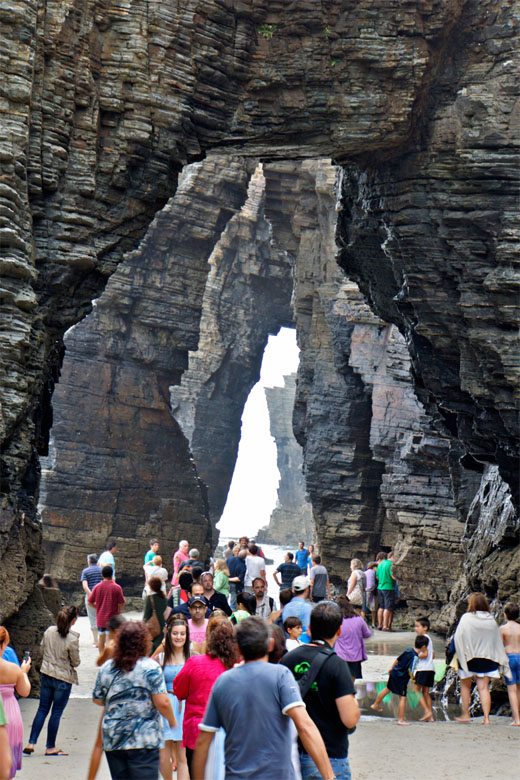
('Beach of the Holy Waters') Beach of the Cathedrals, Spain: Europe’s most beautiful beach


 Beach of the Cathedrals, or Playa de Las Catedrales in Spanish, is situated in the municipality of Ribadeo in the province of Lugo (Galicia), on the Cantabric coast, about ten kilometres to the west from the town of Ribadeo. Although its true name is Holy Waters Beach (Augasantas), it is called ‘the Cathedrals’ because of its giant rock formations that reminds of the flying buttresses of cathedrals.


The most striking feature of the beach are the cluster of impressive rock formations.


 Erosion by wind and the powerful sea have sculpted arches over thirty meters high which can be seen in all its glory at low tide. During low tide you can appreciate the size of its magnificent cliffs and the picturesque sea caves, which go from small cracks on the rock to big caves whose roofs collapse due to the erosion of the waves. Also during low tide you can gain access to a sand deposit delimited by a rocky wall made from slate, dozen-meters-long caves, sand corridors between rocky blocks and many other curiosities.


Wednesday, February 6, 2013

Thor’s Well : A Gate to the Undersea-Cape Perpetua


Many people, I believe even the locals of Oregon do not realize the existence of an amazing nature place called Thor’s Well. Located at Cape Perpetua, Oregon, the surf surge rock without doubt is very unique. In any event, it makes a great photo. It occurs at a moderate to high tide with strong surf. While I think it is best photographed near sunset, I’m sure good photos of it could be obtained almost any time of day. However, it is not easy to take a snap of the place because of sharp rocks are everywhere. Plus, a very strong surge could sweep right up and be very dangerous. The hole can be seen from the parking area at the far end of the rock shelf on the north side of Cook’s Chasm. Following are the photos taken from very brave and dedicated photographers.


Tuesday, January 29, 2013

Calabrian Coast in Southern Italy


Monday, January 28, 2013

Cala Salada Spanish island of Ibiza