Showing posts with label places. Show all posts

Thursday, March 14, 2013

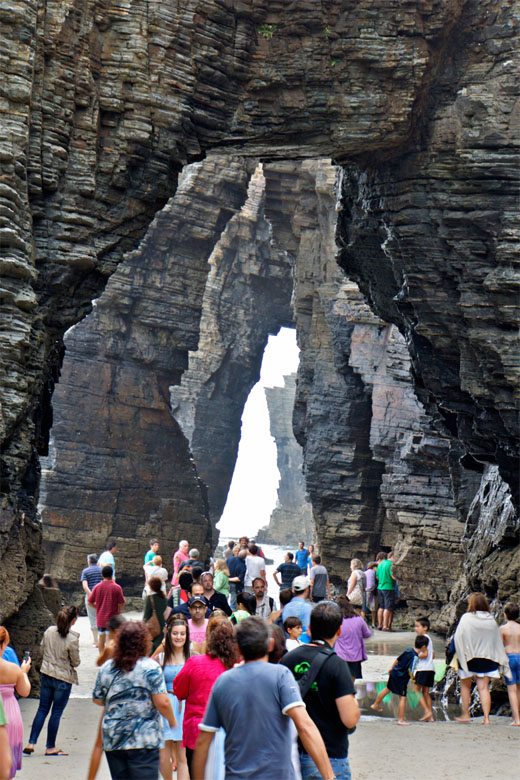
('Beach of the Holy Waters') Beach of the Cathedrals, Spain: Europe’s most beautiful beach


 Beach of the Cathedrals, or Playa de Las Catedrales in Spanish, is situated in the municipality of Ribadeo in the province of Lugo (Galicia), on the Cantabric coast, about ten kilometres to the west from the town of Ribadeo. Although its true name is Holy Waters Beach (Augasantas), it is called ‘the Cathedrals’ because of its giant rock formations that reminds of the flying buttresses of cathedrals.


The most striking feature of the beach are the cluster of impressive rock formations.


 Erosion by wind and the powerful sea have sculpted arches over thirty meters high which can be seen in all its glory at low tide. During low tide you can appreciate the size of its magnificent cliffs and the picturesque sea caves, which go from small cracks on the rock to big caves whose roofs collapse due to the erosion of the waves. Also during low tide you can gain access to a sand deposit delimited by a rocky wall made from slate, dozen-meters-long caves, sand corridors between rocky blocks and many other curiosities.


Wednesday, March 13, 2013

Awesome Colour Striped Icebergs


 Icebergs are formed when large blocks of ice breaks off from glaciers ice shelf and is floating in open water. Because glaciers are built up from snow falling on the Antarctic continent over millennia, this ice consists of pure fresh water. This floating chunk of freshwater ice then interacts with seawater beneath them it.


As seawater is drawn deep under the ice shelves by the oceanic currents, it becomes supercooled and freezes to the base of the ice shelf. Because this ice is formed from seawater that contains organic matter and minerals it causes variety of colour and texture to the iceberg. As the bergs become fragmented and sculpted by the wind and waves, the different coloured layers can develop striking patterns.


Striped icebergs in a variety of colours, including brown, black, yellow, and blue has been spotted in freezing waters around Antarctica. These following images were photographed by Norwegian sailor Oyvind Tangen, on board a research ship around 1,700miles south of Cape Town and 660miles north of the Antarctic in 2008


Awesome Psychedelic Stalactite Formation at Avshalom Cave, Israel


Avshalom Cave also known as Soreq Cave or Stalactites Cave is located on the western slopes of the Judean mountains near Bet Shemesh in Israel. The 5000 square meters cave has one of the most impressive collection of stalactites and stalagmites formed in a variety of patterns. Some of the stalactites hanging from the ceiling of the cave are up to four meters long, and in some cases they fuse with stalagmites growing from the floor. Other formations resemble shelves or sheets of cloth, branches, corals and clusters of grapes, among many other objects. The bizarre patterns at Avshalom Cave combined with the ghostly lightening creates a rather creepy ambience inside the cave.


Stalactites and stalagmites are formed by water flowing from the ceiling to the floor of the cave, melting limestone on the way. Over hundreds of thousands of years, each drop of mineral-laden water deposited a thin layer of calcite on the ceiling and on the ground. Given enough time these tiny layers add up to form columns of calcium carbonate called stalactites and stalagmites.


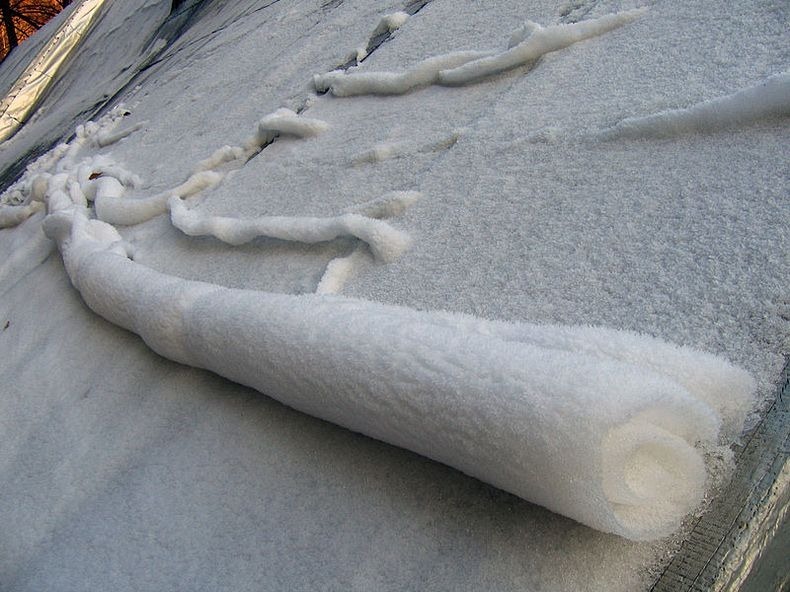
Awesome Snow Roller: A Strange Meteorological Phenomenon


 Snow roller is a rare meteorological phenomenon in which large cylinders of snow are naturally formed as chunks of snow are blown along the ground by wind, picking up material along the way, in much the same way that the large snowballs used in snowmen are made. But unlike snowballs made by people, snow rollers are typically cylindrical in shape, and are often hollow. The inner layers, which are the first layers to form, are weak and thin compared to the outer layers and can easily be blown away, leaving what looks like a doughnut or Swiss roll.


Snow rollers happen with the combination of lying snow and high wind speeds, mostly in North America and Northern Europe, and they can be as small as a tennis ball or they can be as large as two feet across – depending on how strong the wind is and how smooth the surface of the snow is. Gravity can also assist snow roller formation. An inclined surface often needs just a little shove from the wind to get snow rollers in motion.